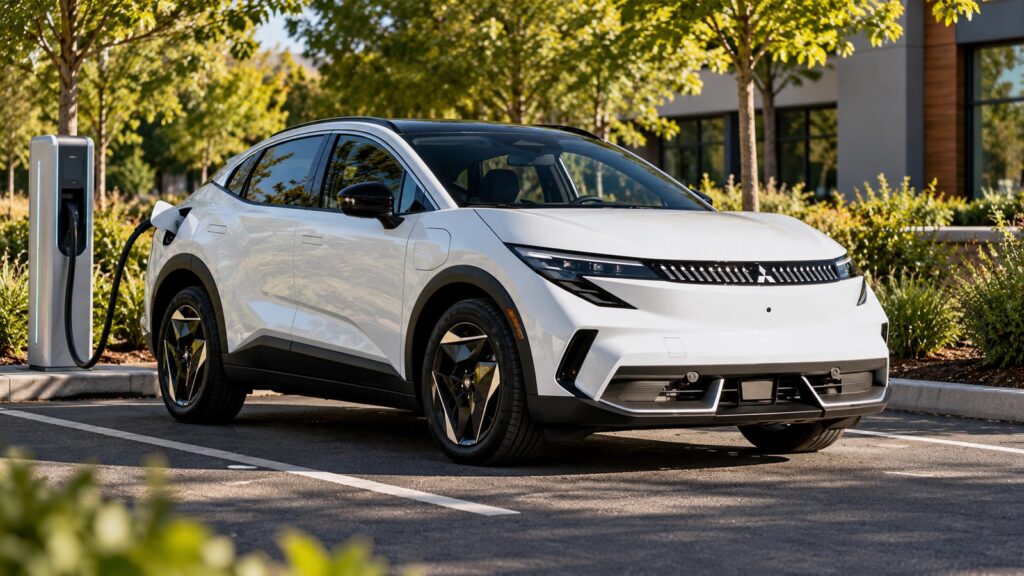
Mitsubishi has priced its first new electric car in nearly a decade, and it’s not the bargain some people expected. The 2027 Eclipse Sportback starts at $37,745, or $39,740 once destination is added. It rides on the same hardware as the Nissan Leaf, and the Leaf starts thousands of dollars lower.
- The 2027 Eclipse Sportback comes in one loaded trim at $37,745, or $39,740 with destination.
- It shares its 75-kWh battery, 214-hp motor and charging hardware with the Nissan Leaf, which starts at $29,990.
- A longer warranty and a refined ride help its case, but the Leaf’s lower prices make the math tough.
A Leaf Under the Skin
Mitsubishi isn’t hiding where this car comes from. The Eclipse Sportback takes its 75-kWh battery, its 214-hp electric motor and its 261 lb-ft of torque straight from the redesigned Nissan Leaf. Power goes to the front wheels, and 0-60 mph takes about seven seconds. That’s plenty for merging onto the highway without much drama.
The two cars share their charging setup too. Both use a NACS port for DC fast charging, top out at 150 kW, and can go from 10% to 80% in around 35 minutes. Range is where they split. The Eclipse has an EPA rating of 282 miles, and the Leaf S+ is rated at 303 miles. So the pricier car also goes a little less far on a charge.
One Trim, One Price, Few Choices
Nissan sells the Leaf in three trims, the S+, SV+ and Platinum+. Mitsubishi keeps things simple with a single, well-equipped version. That makes a straight comparison a bit messy, since the Eclipse comes with more standard gear than a base Leaf.
Still, the numbers are hard to ignore. The Leaf S+ starts at $29,990, which puts the Eclipse $7,755 higher before destination. Even the top Leaf Platinum+ lists at $38,990. Mitsubishi has long had a reputation as a budget brand, so some car writers expected it to undercut its Nissan twin. It went the other way.
There’s one option to think about. A $2,600 Technology Package adds a panoramic sunroof, Bose audio and a power liftgate. Check that box and the Eclipse climbs past $42,000 before taxes and fees.
Where the Eclipse Earns Some Credit
The car itself sounds solid. WardsAuto drove the Eclipse Sportback around Seattle and found it quiet, refined and comfortable. That’s what most people want from an electric commuter, and this one checks those boxes.
Mitsubishi’s warranty is the stronger argument. The Eclipse gets five years or 60,000 miles of vehicle coverage, plus 10 years or 100,000 miles on the battery. The Leaf comes with three years of vehicle coverage and eight years on the battery. For buyers who keep cars a long time, those extra years could be worth real money, and they help close part of the price gap.
Why the Eclipse Name Is Back
For a lot of car fans, the word Eclipse means something very different. The original was a turbocharged coupe with the 4G63 engine, a tuner favorite and a star of the first Fast & Furious movie. The new crossover has no turbo, no manual gearbox and no coupe doors.
What it does have is name recognition. Mitsubishi is betting that a familiar badge will pull shoppers into showrooms. The Eclipse Sportback is also the first new vehicle under the brand’s Momentum 2030 plan, which calls for at least one new or heavily refreshed model every year. A refreshed Outlander and a new pickup are also part of that plan. And this car brings Mitsubishi back to the U.S. EV market nearly a decade after it stopped selling the i-MiEV here in 2017.
Drive Both Before You Pay for the Badge
The Eclipse Sportback reaches U.S. dealerships in October, so you’ll be able to see one in person soon. If you’re cross-shopping, line it up against a Leaf SV+ or Platinum+ with similar features. Then weigh the price difference against Mitsubishi’s longer warranty. Ask yourself whether you’d really use the sunroof, Bose audio and power liftgate in the Technology Package. If your commute is long, keep the 21-mile range gap versus the Leaf S+ in mind too.
For some buyers, five years of vehicle coverage and a decade of battery protection will justify the higher sticker. Others will see the matching hardware and keep the savings. Either way, the same capable electric car sits underneath, so pick the deal that fits your budget and your daily drive.
This post may contain affiliate links. Meaning a commission is given should you decide to make a purchase through these links, at no cost to you. All products shown are researched and tested to give an accurate review for you.