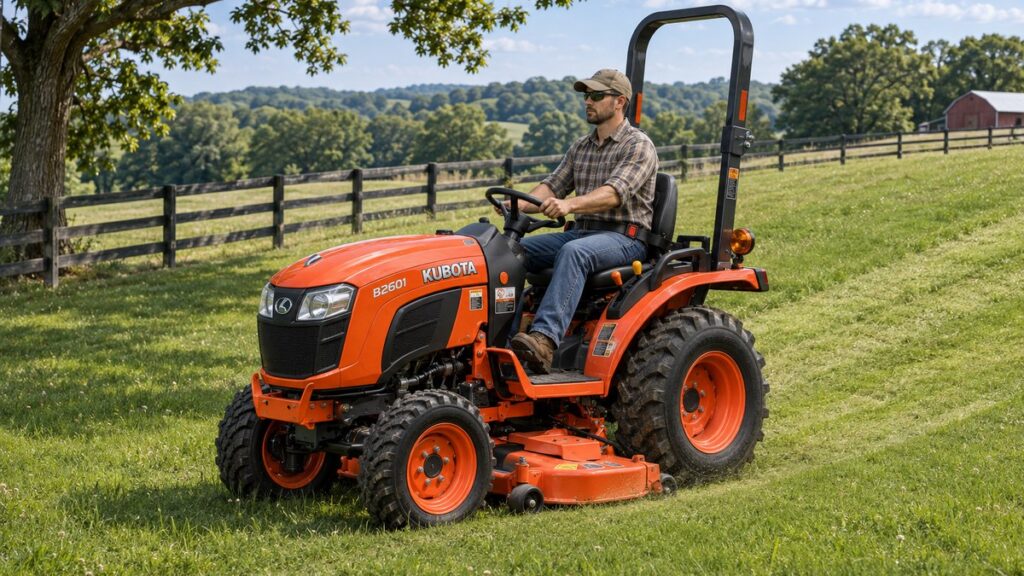
Small tractors feel easy and friendly. They mow, haul, and dig without much fuss. But a tractor sits tall, and when one starts to tip, there’s very little time to react. The frame over your seat and the belt across your lap work as a team. If either one is missing, the team falls apart.
- A rollover protective structure (ROPS) gives a belted operator protected space in an overturn, reducing crushing risk without guaranteeing survival.
- The seat belt keeps you inside that space, and the belt and structure provide the most protection when used together.
- Overturns are a major cause of tractor-related deaths, and since 1985 manufacturers have voluntarily made ROPS standard on farm tractors over 20 horsepower sold in the U.S.
Why Small Tractors Tip in the First Place
Tractors have a high center of gravity, often work on rough or uneven ground, and many carry heavy implements mounted on the back. On a slope or near a ditch, a routine job can turn dangerous fast.
According to NIOSH, tractor overturns are a major cause of tractor-related deaths. France’s agriculture ministry says overturns do more harm to the driver than any other type of tractor accident and make up roughly half of fatal tractor accidents. It also warns that flat ground and very low speeds don’t rule one out.
How a ROPS Creates a Survival Zone
A ROPS is a sturdy safety frame or cage installed on a tractor to protect the operator if the machine rolls over, sometimes called a roll bar.
According to NIOSH and Extension safety guidance, a rollover frame gives a belted operator room to stay clear of the tractor and the ground during an overturn. It reduces the risk of crushing but does not stop the rollover or guarantee survival.
That protected room is the survival zone. A properly installed ROPS creates the protected space. Keep any folding frame raised and locked, and wear the seat belt so you stay inside that space if the tractor tips.
Why the Seat Belt Matters So Much
The frame guards a fixed area around the seat but can’t follow you if you slide or fall out. The belt keeps your body inside the zone the frame protects.
Tractor safety checklists pair the two every time: use a ROPS, and wear the seat belt with it.
Checking a Folding Frame or a Retrofit Kit
A folding ROPS can be lowered for clearance, which means it can also be left down or half secured by mistake. After raising it, confirm that every pin, latch, or locking device at the hinge points is fully engaged as your operator’s manual describes. If a pin is missing, bent, or won’t seat, treat the tractor as unprotected until it is fixed.
For a retrofit, look for a structure the tractor’s manufacturer has approved for that exact model. Contact the manufacturer with the model and serial number to ask whether an approved kit exists. Skip homemade frames and parts built for another machine, since no one can know how they would hold up in a real overturn.
Older Tractors and the Retrofit Question
According to Penn State Extension, beginning in 1985 manufacturers voluntarily made rollover protection standard on farm tractors over 20 horsepower sold in the U.S. Check the specific tractor rather than assuming its model year tells you.
Use a tractor equipped with an approved rollover structure and a seat belt. If your older tractor lacks protection, check for a tested retrofit designed for that model before putting it back in service. If none is available, retire it from operation. A seat belt alone is not a substitute for a rollover structure. ROPS rebate programs exist to help owners with this exact hazard.
In Wisconsin, a family who lost someone in a 2009 rollover has shared their story publicly to raise awareness about ROPS on older equipment.
Buckle Up Whenever Your Tractor Has a ROPS
A ROPS gives you protected space, and your seat belt keeps you in it. Before operating, make sure the tractor has an approved rollover structure, any folding frame is raised and locked, and your seat belt is fastened. If it lacks rollover protection, follow the retrofit or retirement steps above. Buckling up takes a few seconds, and those seconds matter most on the day the ground gives way.
This post may contain affiliate links. Meaning a commission is given should you decide to make a purchase through these links, at no cost to you. All products shown are researched and tested to give an accurate review for you.